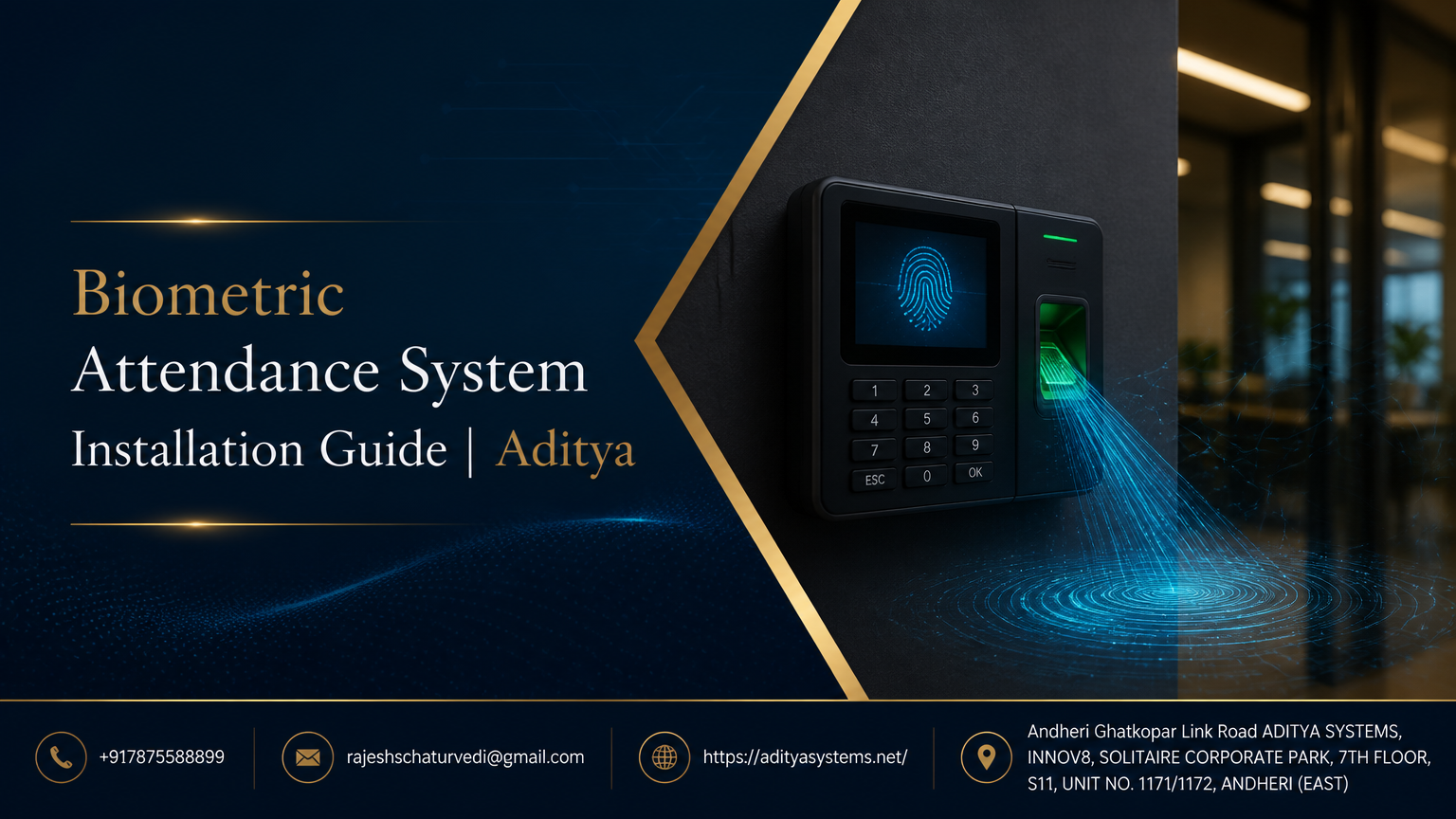
Biometric Attendance System Installation Guide | Aditya
Biometric Attendance System Installation Guide for 2026: Everything Indian Offices Need to Know
Manual attendance registers, swipe cards, and buddy punching — Indian workplaces have tolerated these inefficiencies for far too long. The result? Payroll inaccuracy, lost productivity, and zero accountability. A professional biometric attendance system installation solves all three problems at once, giving HR teams real-time data and employees a frictionless check-in experience. But getting the setup right involves more than mounting a device on a wall. From choosing the right biometric modality to complying with India’s Digital Personal Data Protection Act, every step matters. With nearly two decades of experience since 2005, Aditya Systems has helped offices, factories, and housing societies across Mumbai implement reliable attendance infrastructure. In this guide, we walk you through the entire process — types, benefits, installation steps, legal compliance, and expert advice — so you can make an informed decision before your next deployment.
TL;DR / Quick Answer
Biometric attendance system installation involves mounting a fingerprint, face-recognition, or palm-vein device, connecting it to your local network, integrating it with HR/payroll software, enrolling employees, and ensuring DPDP Act 2023 compliance. Professional installation typically takes 1–3 days depending on site size and device count. With the market projected to reach $6.9 billion by 2034 (Research Intelo, 2026), now is the optimal time for Indian businesses to upgrade from manual registers to biometric tracking.
Table of Contents
- What Is a Biometric Attendance System?
- Key Benefits of Professional Biometric Attendance System Installation
- Types of Biometric Attendance Systems for Indian Workplaces
- Step-by-Step Installation Process
- DPDP Act Compliance: What Indian Offices Must Know
- Common Installation Mistakes and How to Avoid Them
- Expert Insights: Trends Shaping Biometric Attendance in 2026
- FAQs
What Is a Biometric Attendance System?
A biometric attendance system is a hardware-and-software solution that identifies employees through unique physiological or behavioral traits — fingerprints, facial geometry, iris patterns, or palm veins — and automatically records their clock-in and clock-out times. Unlike RFID cards or PIN-based systems, biometric identifiers cannot be shared, forgotten, or forged, which makes them the most reliable method for tracking workforce presence. Modern devices store encrypted biometric templates either on-device or on a secure server and transmit attendance logs to HR or payroll software in real time via LAN, Wi-Fi, or cloud connectivity. According to Research Intelo’s 2026 market report, the global biometric time attendance market was valued at $2.8 billion in 2025, with Biometric Attendance Systems and facial recognition solutions holding the largest segment share at 43.5%.
For Indian businesses specifically, the shift is being accelerated by government digitization mandates and the need for audit-ready payroll records. Whether you run a 10-person startup or a 1,000-seat factory, the core components remain the same: a biometric reader unit, a controller or server, network cabling, management software, and — critically — professional installation that ensures proper placement, stable connectivity, and compliant data handling. Skipping any of these steps leads to false rejections, network drops, or legal exposure under India’s data protection framework.
Key Benefits of Professional Biometric Attendance System Installation
The most immediate benefit is eliminating buddy punching — the practice of one employee clocking in for another. The American Payroll Association and SHRM estimate that buddy punching costs businesses 2.2% of gross payroll annually, with biometric systems reducing this figure by up to 95%. For a 500-person company, that translates to a payback period of just three to six months purely from recovered payroll leakage. Beyond fraud prevention, professional installation ensures optimal device placement (eye-level for face readers, accessible-height for fingerprint scanners), stable PoE or Wi-Fi connectivity, and seamless integration with existing HR software so data flows automatically into payroll calculations without manual CSV exports.
A professionally installed system also delivers operational advantages that DIY setups rarely match. These include structured cable management that prevents signal interference, firmware configuration tuned to local lighting and humidity conditions, multi-device synchronization across buildings or floors, and Aditya Systems’ comprehensive AMC services that keep devices online year-round. Customer Arpita P highlights this hands-on approach: “Excellent services and solutions provided by them. Always provides on-time service.” When your attendance system goes down on a Monday morning, having a local service partner with prompt response guarantees is the difference between a five-minute fix and a full-day HR crisis.
Types of Biometric Attendance Systems for Indian Workplaces
Fingerprint scanners remain the most widely deployed biometric attendance devices in India thanks to their affordability, compact form factor, and fast verification speed (typically under one second). They work well for offices, retail stores, and educational institutions where environmental conditions are controlled. However, factories with dusty or wet environments, or healthcare settings requiring glove use, may experience higher false rejection rates. For these scenarios, contactless alternatives — facial recognition and iris scanners — eliminate the hygiene and surface-contamination concerns entirely. AI-based face reader devices, in particular, can verify identities even when employees wear masks or glasses, making them ideal for hospitals, food processing plants, and post-pandemic offices.
Palm-vein and multi-modal systems sit at the premium end, combining two or more biometric inputs for maximum accuracy. They are commonly deployed in high-security facilities such as data centers, R&D labs, and government buildings. The right choice depends on your workforce size, environment, security level, and budget — which is why a pre-installation site survey is essential. Attendance & Access Control Solutions from Aditya Systems include consultation to match the right device type to your specific operational requirements, whether you need a single-door fingerprint unit or a multi-site AI face reader deployment with integrated access control gates.
Step-by-Step Biometric Attendance System Installation Process
Professional biometric installation follows a structured sequence. It begins with a free site survey where a technician evaluates your premises — entry points, network infrastructure, lighting conditions, and power availability — then delivers an itemized quotation covering hardware, cabling, software licenses, and labor. Once approved, the physical installation phase starts: mounting brackets are fixed at recommended heights (typically 1.2–1.4 meters for face readers), Cat6 or PoE cables are routed through conduits to avoid signal degradation, and devices are connected to the local network. The technician then assigns static IPs, configures NTP servers for accurate time-stamping, and tests each reader for response time and rejection accuracy.
After the hardware is live, the software integration phase begins. The management platform is installed on a local server or configured for cloud access, employee profiles are created, and biometric enrollment is conducted — each user scans their fingerprint or face multiple times to build a reliable template. Finally, the system is connected to your HR or payroll software via API or file-based sync, and the entire deployment is stress-tested with a simulated peak-hour check-in scenario. Aditya Systems’ transparent, customized quotation process eliminates guesswork at every stage, and customers receive a detailed installation timeline alongside the quote so project managers can plan around the deployment without disrupting daily operations.
DPDP Act Compliance: What Indian Offices Must Know
India’s Digital Personal Data Protection Act, 2023 (Act No. 22 of 2023) classifies biometric data as personal data requiring explicit, standalone, unbundled consent — meaning you cannot bundle attendance consent into a general employment agreement or rely on a pre-ticked checkbox. The law mandates Data Protection Impact Assessments for biometric deployments, on-device template storage where technically feasible, AES-256 encryption for centrally stored templates, and TLS 1.3 for data in transit. Perhaps most critically, employers must delete former employees’ biometric templates within a defined period — commonly seven days post-exit — or face penalties of up to ₹250 crore per instance. Non-compliance is not just a legal risk; it erodes employee trust.
Practical compliance starts during installation. A qualified installer should configure consent-collection workflows (digital or physical), enable on-device storage modes on supported hardware, activate encryption on every data channel, and set automated deletion schedules tied to your HR exit process. They should also help you draft the mandatory notice to employees explaining what data is collected, how it is processed, and how long it is retained. Because Aditya Systems’ free consultation covers both the technical and advisory aspects of a deployment, businesses can address DPDP compliance at the installation stage rather than scrambling to retrofit it later — a far more cost-effective and legally defensible approach.
Common Installation Mistakes and How to Avoid Them
The most frequent mistake is choosing the wrong device for the environment. Installing a capacitive fingerprint scanner in a factory with airborne particulates, or placing a face reader in a dimly lit corridor without supplementary lighting, guarantees high false rejection rates and frustrated employees. A professional site survey identifies these environmental factors before hardware is purchased, saving you from costly rework. Another common error is poor network planning — running biometric devices on the same network segment as bandwidth-heavy CCTV streams or relying on a single Wi-Fi access point for dozens of readers. Network segmentation, dedicated VLANs, and PoE switches sized for the total device load are non-negotiable for reliable performance.
Skipping post-installation testing is equally damaging. If enrollment templates are captured under different lighting or angles than actual check-in conditions, the system will produce false rejections during peak hours. Stress-testing the system at shift-change times, enrolling employees under realistic conditions, and verifying API sync with payroll software before go-live prevents the embarrassing scenario of a “live” system that HR cannot actually use. Finally, neglecting ongoing maintenance — firmware updates, sensor cleaning, backup verification — turns a well-installed system into a liability within months. Pairing your installation with a reliable Annual Maintenance Contract ensures the same standard of performance on day 300 as on day one.
Expert Insights: Trends Shaping Biometric Attendance in 2026
Three trends are redefining biometric attendance this year. First, AI-powered face recognition has moved from premium to mainstream — the 43.5% segment share it held in 2025 is expected to grow further as device costs drop below ₹5,000 per unit in India. Second, cloud-managed attendance platforms are replacing on-premise servers, enabling multi-location businesses to monitor attendance from a single dashboard and reducing IT infrastructure costs. Third, integration depth is increasing: modern systems now connect not just to payroll but to access control, visitor management, and even cafeteria billing, creating a unified employee identity layer across the workplace.
For Indian businesses evaluating a biometric attendance system installation in 2026, the advice from experienced integrators is consistent: start with a site survey, prioritize DPDP compliance from day one, choose a modality that matches your environment rather than the cheapest option available, and invest in an AMC to protect your hardware investment. Aditya Systems has been delivering these integrated security and communication solutions since 2005, with authorized partnerships with leading OEMs including BIOMAX, eSSL, and Matrix, and thousands of products shipped Pan India. As the Asia Pacific region drives 36.2% of global biometric revenues — powered largely by India’s digitization push — businesses that act now gain a measurable productivity advantage over competitors still relying on manual registers.
Conclusion
A well-planned biometric attendance system installation delivers measurable ROI within months — from eliminating buddy punching to automating payroll and ensuring DPDP compliance. The key is professional implementation: the right device for your environment, structured network integration, legally compliant consent workflows, and ongoing maintenance. Whether you manage a corporate office in Andheri, a factory in Navi Mumbai, or a residential society in Dombivli, expert guidance makes the difference between a system that works on day one and one that still works reliably two years later. Ready to upgrade your attendance infrastructure? Book your biometric installation today with Aditya Systems — get a free site survey, transparent quotation, and nearly 19 years of proven expertise.
Frequently Asked Questions
What is biometric attendance system installation?
Biometric attendance system installation is the professional process of mounting biometric reader hardware (fingerprint, face recognition, or palm-vein devices), connecting them to a local network, integrating the software with HR or payroll systems, enrolling employees, and configuring compliance settings — typically completed in one to three days by a certified technician.
How much does biometric attendance system installation cost in India?
Costs vary based on device type, brand, number of units, cabling complexity, and software licensing. Aditya Systems provides a free site survey and transparent, itemized quotation with no hidden costs — contact them at 9323299888 or via their contact page for a custom estimate.
Which biometric modality is best for Indian offices?
Fingerprint scanners suit standard office environments with controlled conditions. AI-based face readers are ideal for contactless verification in healthcare, food processing, or high-traffic lobbies. Palm-vein systems serve high-security facilities. The best choice depends on your environment, workforce size, and security requirements — a professional site survey determines the right fit.
Does the DPDP Act affect biometric attendance systems?
Yes. Under India’s Digital Personal Data Protection Act, 2023, biometric data requires explicit standalone consent, AES-256 encryption, and mandatory deletion of former employees’ templates. Non-compliance can result in penalties up to ₹250 crore. Professional installers should configure these compliance settings during deployment.
Can biometric attendance integrate with payroll software?
Modern biometric systems integrate with HR and payroll platforms via API or file-based synchronization, automatically transferring clock-in/out data for accurate salary calculations without manual CSV exports.
How long does a typical installation take?
A single-door fingerprint installation for a small office can be completed the same day. Multi-device, multi-floor deployments with network cabling and software integration typically take one to three days depending on site complexity.
What ongoing maintenance is required?
Biometric devices need periodic sensor cleaning, firmware updates, backup verification, and network health checks. An Annual Maintenance Contract from a reliable provider ensures continuous performance and prompt technical support.
Does Aditya Systems install biometric systems outside Mumbai?
Aditya Systems ships products Pan India across the country. On-site installation and maintenance services are available in the Mumbai Metropolitan Region including Andheri, Malad, Goregaon, Navi Mumbai, and surrounding areas. For locations outside this zone, contact their team to discuss available options.
For more insights on security and attendance technology, read more on the Aditya Systems blog.