IP CCTV Camera System for Office in Mumbai – Camera, NVR & Installation Guide
Installing CCTV in an office is no longer simply a matter of placing a few cameras near the entrance. A properly planned IP CCTV camera system in Mumbai should help you monitor important areas, record usable footage, access cameras remotely and provide enough storage for your actual security requirements.
However, businesses often begin by asking only one question: What is the CCTV camera price?
A better starting point is: What exactly do you need the CCTV system to monitor?
The answer determines the camera type, resolution, number of cameras, NVR capacity, storage requirement, network design and installation plan.
Quick Answer: What Is an IP CCTV Camera System?
An IP CCTV system uses network cameras to transmit video through an IP network to an NVR or other supported monitoring infrastructure.
For an office, warehouse, shop, school, hospital or commercial building, an IP-based setup can be useful when you need high-resolution surveillance, remote viewing, expandable recording and centralized monitoring.
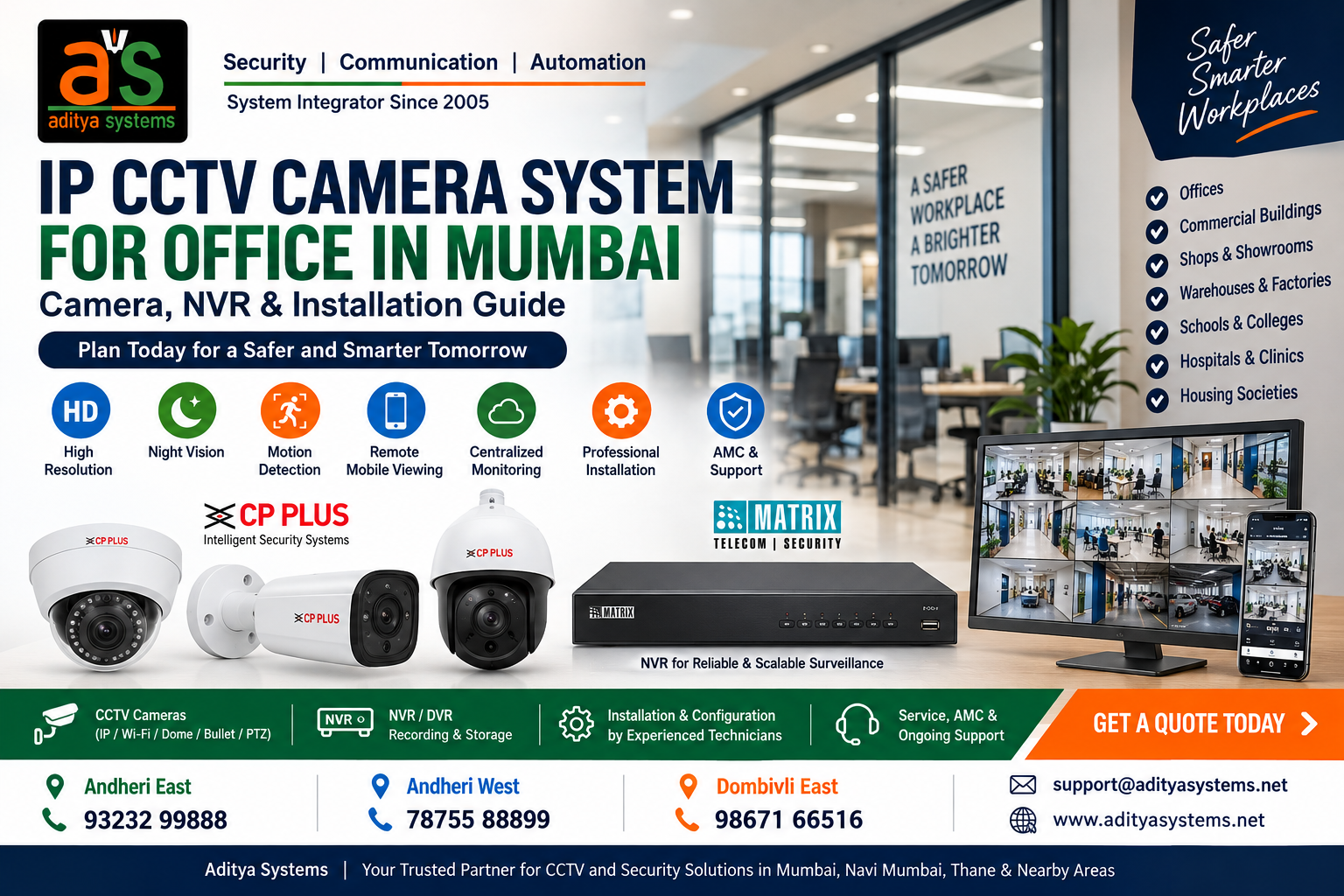
Aditya Systems currently provides CCTV camera installation and support using brands including CP PLUS and Matrix, alongside its other security and communication solutions.
Step 1: Decide Where CCTV Cameras Are Actually Required
Before choosing a camera model, identify the areas that genuinely require monitoring.
For an office, these commonly include entrances and exits, reception areas, passages, server or equipment areas, parking zones, warehouses and other sensitive locations.
Camera placement matters because simply increasing the number of cameras does not automatically improve security.
Instead, each camera should have a clear purpose.
For example, a camera monitoring a reception desk may require a different field of view from a camera monitoring a parking entrance.
Therefore, a site survey and requirement discussion can help avoid unnecessary cameras while reducing important blind spots.
Step 2: Choose the Right CCTV Camera Resolution
Resolution is an important consideration, but more megapixels are not automatically better for every location.
The correct choice depends on the viewing distance, coverage area, available storage and the level of detail required.
Aditya Systems’ current product catalogue includes different CP PLUS CCTV options, including IP-camera models. For example, a listed CP PLUS 4MP dual-light IP camera supports a resolution up to 2688 × 1520 and includes IR and warm-light illumination capabilities.
Consequently, rather than selecting a camera purely from its megapixel number, businesses should consider the complete surveillance requirement.
Step 3: Select the Correct NVR
The Network Video Recorder (NVR) is an important part of an IP CCTV system because it manages and records feeds from network cameras.
If eight cameras are required today, buying an NVR with no room for future expansion may not always be the most practical decision.
Consider both your present requirement and realistic future growth.
Aditya Systems currently lists a CP PLUS 8-channel NVR that supports eight IP-camera inputs, H.265/Smart H.264+ decoding, up to 8MP preview/playback and one SATA HDD.
The website also lists Matrix SATATYA NVR models. One current 16-channel model includes two SATA ports and supports multiple video resolutions and H.265/H.264 compression.
The appropriate NVR should therefore be selected according to camera quantity, resolution, recording requirements, storage and future expansion.
Step 4: Calculate CCTV Storage Properly
Storage is frequently underestimated when CCTV systems are purchased.
Recording duration depends on several factors, including the number of cameras, camera resolution, frame rate, compression settings, recording mode and HDD capacity.
For example, a business that wants longer recording retention across many high-resolution cameras will generally require more storage than a small office using fewer cameras.
Therefore, asking only for a “1TB CCTV system” or “2TB CCTV system” without considering these variables can lead to unrealistic expectations.
A professional CCTV proposal should match HDD capacity with the actual recording requirement.
Step 5: Consider Remote Mobile Viewing
Modern CCTV systems can provide remote viewing through supported applications and network configurations.
This can be particularly useful for business owners and managers who want to monitor their premises while travelling or working from another location.
Aditya Systems’ existing CCTV installation content specifically includes remote mobile access among the surveillance features it supports.
However, remote viewing should be configured correctly rather than treated as an afterthought during installation.
Centralized CCTV Monitoring for Multiple Locations
Businesses operating several offices, branches, warehouses or commercial locations may need something beyond independent CCTV systems.
In such situations, centralized CCTV monitoring can make surveillance easier to manage.
Instead of treating every branch as an isolated installation, compatible systems can be planned around centralized viewing and recording requirements.
Aditya Systems currently highlights centralized monitoring for offices, warehouses, schools, hospitals, commercial buildings and societies on its CCTV installation content.
This makes centralized surveillance particularly relevant for companies with operations across Mumbai, Navi Mumbai, Thane or multiple branches.
IP CCTV vs Traditional CCTV: Which Should You Choose?
There is no single answer suitable for every property.
An IP CCTV system may be preferred when the requirement involves network-based cameras, higher-resolution options, scalable NVR recording or centralized surveillance.
Meanwhile, an existing property may already have usable CCTV infrastructure that should be evaluated before replacing everything.
Therefore, the right approach is to first examine the existing cabling, recorder, cameras, network and actual security objective.
Replacing equipment unnecessarily can increase project cost without providing proportional benefit.
Don’t Ignore Network Infrastructure
Because IP cameras operate over a network, network planning is part of CCTV planning.
For larger systems, installers need to consider network switches, bandwidth, cable distances, PoE requirements, recorder connectivity and remote-access requirements.
A powerful camera cannot compensate for poorly planned connectivity.
As a result, IP CCTV installation is both a surveillance project and a network-infrastructure project.
CCTV Installation for Offices, Societies and Commercial Properties
Different properties require different surveillance strategies.
An office may prioritize entry points, reception, passages and sensitive rooms. A housing society may need gates, parking areas, lobbies and common areas. Warehouses may require wider coverage and longer recording retention.
Likewise, retail outlets may focus on entrances, billing areas and stock zones.
Therefore, CCTV design should start with the property and security requirement rather than with a particular camera model.
Why Professional CCTV Installation Matters
Buying genuine CCTV hardware is only one part of a successful surveillance system.
Camera positioning, mounting height, cabling, NVR configuration, HDD setup, network connectivity, mobile viewing and testing all influence the final result.
Professional commissioning also helps confirm that cameras are recording correctly before the system is handed over.
Aditya Systems provides CCTV installation as well as testing, maintenance, repair, upgrades and ongoing technical support.
CCTV Solutions Across Mumbai and Nearby Areas
Aditya Systems has been providing security and communication solutions since 2005 and currently offers CCTV cameras, attendance and access control, EPABX, society intercom and fire alarm solutions. It also provides AMC services for CCTV and several other systems.
For customers looking for CCTV installation in Mumbai, support is available for requirements across Andheri East, Andheri West, Dombivli, Navi Mumbai, Thane and nearby areas.
Contact Aditya Systems
Andheri East
Unit No. 1171/1172, 7th Floor, S11, Innov8, Solitaire Corporate Park, Andheri (East) – 400093
9323299888
Andheri West
Unit No. 8, Andheri Industrial Estate, Off Veera Desai Road, Andheri (West), Mumbai – 400053
7875588899
Dombivli East
503, A7, Shankheshwar Nagar, Phase 1, Dombivli East, Kalyan, Maharashtra – 421201
9867166516
Email: support@adityasystems.net
Aditya Systems website
Frequently Asked Questions
Which CCTV camera is best for an office?
There is no single camera that is best for every office. The correct choice depends on the monitoring area, required detail, lighting, viewing distance, recording duration and budget. A combination of different camera types may be more suitable than using one model everywhere.
What is an NVR in a CCTV system?
An NVR, or Network Video Recorder, receives and records video from compatible IP/network cameras. NVR capacity should be selected according to the number of cameras, required resolution, storage and future expansion.
How much CCTV storage does an office need?
CCTV storage depends on camera quantity, resolution, frame rate, compression, recording schedule and required retention period. Therefore, HDD capacity should be calculated for the particular project instead of using one fixed storage figure for every installation.
Can office CCTV cameras be viewed on a mobile phone?
Many modern CCTV systems support remote viewing through compatible mobile applications when the system and network are configured appropriately.
Can CCTV cameras from multiple branches be monitored centrally?
Compatible CCTV systems can be designed for centralized monitoring, making this useful for organizations operating multiple offices, warehouses or branches.
Does Aditya Systems provide CCTV AMC and service?
Yes. The company’s current website lists both comprehensive and non-comprehensive AMC options and includes CCTV cameras among the systems covered by its AMC services.
Final Word
A reliable IP CCTV camera system in Mumbai should not be selected only by camera price or megapixel count.
Start with the areas that need surveillance. Then select suitable cameras, NVR capacity, HDD storage, network infrastructure and remote-monitoring requirements.
When those elements are planned together, the CCTV system is more likely to provide useful surveillance today while remaining practical as your security requirements grow.