Choosing the Right Biometric Attendance Device: A Practical Comparison
Not every office needs the same biometric attendance device — a 20-person startup and a 300-person manufacturing floor have genuinely different requirements for capacity, speed, and authentication methods. Aditya Systems offers a real range worth comparing properly before you buy.
Why Biometric Beats Cards and PINs
Unlike RFID cards or PIN-based systems, biometric identifiers cannot be shared, forgotten, or forged, which makes them the most reliable method for tracking workforce presence.
Three Real Biomax Devices, Compared
| Model | Face ID | Fingerprint | Card | Log Capacity | Verification |
|---|---|---|---|---|---|
| IndigoFace 6 | 2,000 | 10,000 | 2,000 | 200,000 | <1 second |
| MultiBio 500 | 1,500 | 5,000 | Mifare | 3,000 | — |
| MultiBio 900 | 3,000 | 10,000 | 3,000 | 200,000 | — |
These aren’t marketing generalities — real, specific capacity numbers across face ID, fingerprint, and card storage let a business genuinely match a device to actual workforce size, rather than guessing at whether a given model can handle their headcount.
Why the MultiBio 900’s Triple Authentication Matters
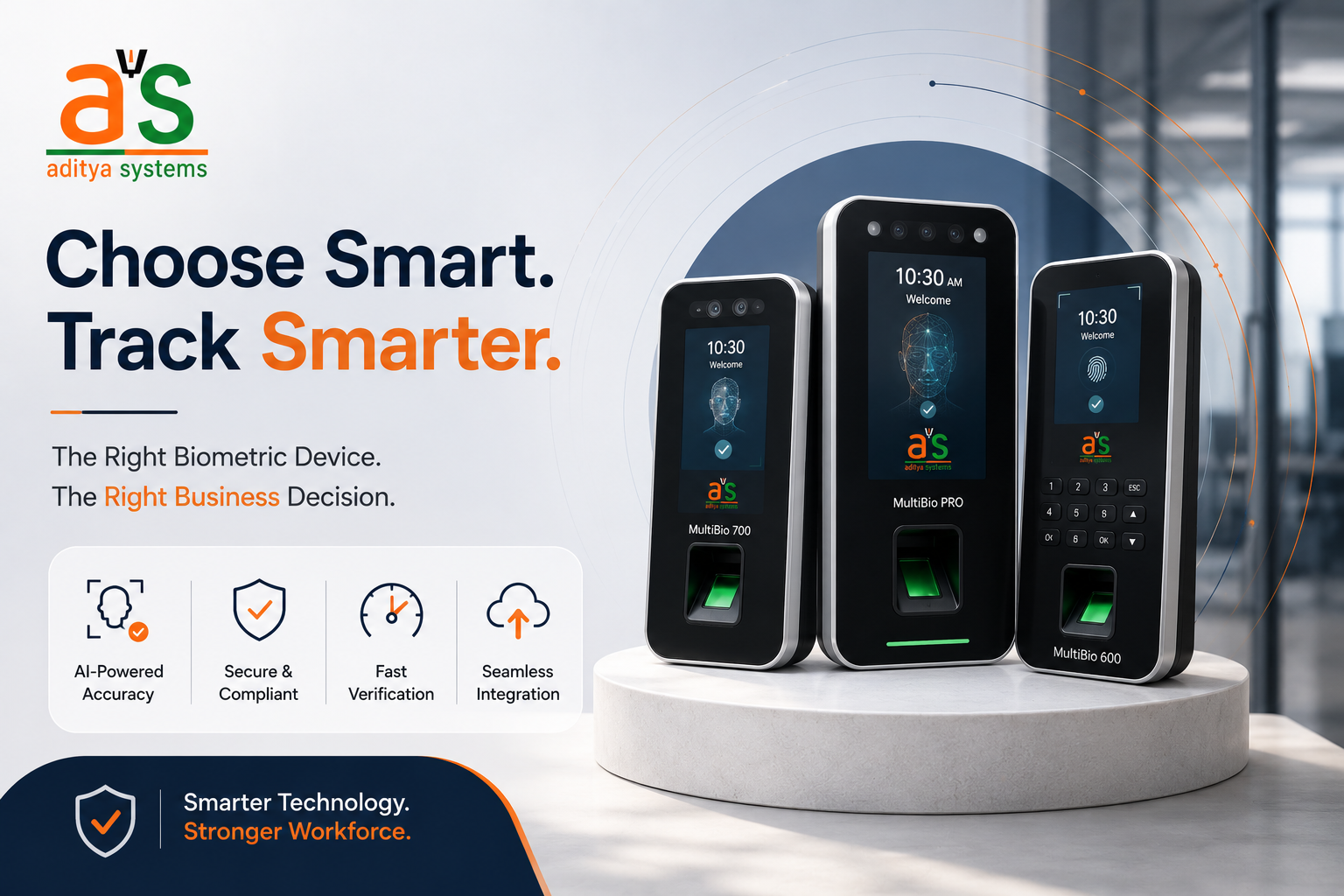
The Biomax Multibio 900 supports three biometric authentication modes: face recognition, fingerprint scanning, and card-based identification. Offering multiple authentication paths on a single device gives a business genuine flexibility — some employees may prefer face recognition, others fingerprint, and having both available on one unit avoids forcing every employee through an identical process.
Why Compact Design Still Gets Specific Attention
With dimensions of 185 x 90 x 23.8 mm, the Biomax Multibio 900 has a sleek and compact design that fits seamlessly into any office environment. Despite its small size, it offers remarkable durability and functionality — a detail worth noting for offices with limited wall space near entry points, where a bulky device genuinely becomes a practical installation constraint.
The Real Installation Process, Step by Step
1MountingDevice installed near the main entrance or a defined checkpoint, at a height comfortable for use.
2Network ConnectionConnecting to your local network, typically via TCP/IP or Wi-Fi.
3HR/Payroll IntegrationLinking attendance data with existing HR and payroll software.
4Employee EnrollmentCapturing biometric data for each employee directly on the device.
5DPDP Act 2023 ComplianceEnsuring the deployment meets India’s current data protection regulatory requirements.
Professional installation typically takes 1–3 days depending on site size and device count — a specific, realistic timeframe rather than a vague “quick and easy” claim.
Why DPDP Act 2023 Compliance Genuinely Matters Here
Biometric data is inherently personal and sensitive — a fingerprint or facial profile can’t be reset the way a password can. Ensuring DPDP Act 2023 compliance as an explicit step in the installation process reflects genuine attention to India’s current data protection regulatory framework, not treating biometric enrollment as a purely technical task disconnected from legal obligation.
A Growing, Genuinely Sizeable Market
With the market projected to reach $6.9 billion by 2034 (Research Intelo, 2026), now is the optimal time for Indian businesses to upgrade from manual registers to biometric tracking. This kind of market growth trajectory reflects genuine, sustained industry momentum, not a temporary trend likely to lose relevance.
Where High-Security Deployment Matters Most
Biometric attendance systems are commonly deployed in high-security facilities such as data centers, R&D labs, and government buildings — reflecting genuine relevance beyond standard office attendance tracking, extending into contexts where identity verification carries real security stakes, not just administrative convenience.
Why a Pre-Installation Consultation Matters
The right choice depends on your workforce size, environment, security level, and budget — which is why a pre-installation site survey is essential. Attendance & Access Control Solutions from Aditya Systems include consultation to match the right device type to your specific operational requirements, whether you need a single-door fingerprint unit or a multi-site AI face reader deployment with integrated access control gates.
A Practical Checklist for Choosing Your Device
- Match capacity to your actual headcount. Face ID, fingerprint, and card capacity vary significantly across models like IndigoFace 6, MultiBio 500, and MultiBio 900.
- Consider whether multiple authentication modes matter for your workforce. Triple-mode devices offer flexibility a single-mode unit can’t.
- Factor in physical installation constraints. Compact dimensions matter for space-limited entry points.
- Plan for the full installation timeline. 1–3 days depending on site size and device count, including HR/payroll integration and enrollment.
- Confirm DPDP Act 2023 compliance is explicitly addressed. Biometric data deserves genuine regulatory attention, not an afterthought.
Get a Device Matched to Your Actual Requirements
A pre-installation site survey, real device comparison, and full DPDP Act-compliant installation — from Aditya Systems, Mumbai.Call 7875588899 →
Frequently Asked Questions
What’s the difference between the Biomax IndigoFace 6 and MultiBio models?
They differ in capacity — IndigoFace 6 supports 2,000 Face IDs and 10,000 fingerprints, while MultiBio 900 supports 3,000 Face IDs, 10,000 fingerprints, and adds card-based authentication as a third mode.
How long does installation actually take?
Typically 1–3 days, depending on site size and the number of devices being installed.
Does installation address data protection compliance?
Yes — ensuring DPDP Act 2023 compliance is an explicit part of the installation process.
Is a site survey necessary before choosing a device?
Yes — the right device depends on workforce size, environment, security level, and budget, making a pre-installation site survey and consultation essential.
Final Thoughts
Choosing a biometric attendance device isn’t a one-size-fits-all decision — face ID and fingerprint capacity, authentication modes, physical dimensions, and installation requirements all genuinely differ across real models like the IndigoFace 6, MultiBio 500, and MultiBio 900. Matching the right device to actual workforce size and environment matters far more than simply picking whichever unit is cheapest.
With a real, structured installation process covering network integration, employee enrollment, and DPDP Act 2023 compliance, Aditya Systems helps Mumbai businesses move from manual registers to biometric attendance tracking that’s actually matched to their genuine operational needs.
Note: This article reflects the products and information published by Aditya Systems on adityasystems.net at the time of writing, including a market projection cited by Aditya Systems from Research Intelo (2026). Device availability and pricing may vary; please contact Aditya Systems directly for a current site survey and quote.
© 2026 Aditya Systems • adityasystems.net • Andheri, Mumbai • +91-7875588899 • support@adityasystems.net